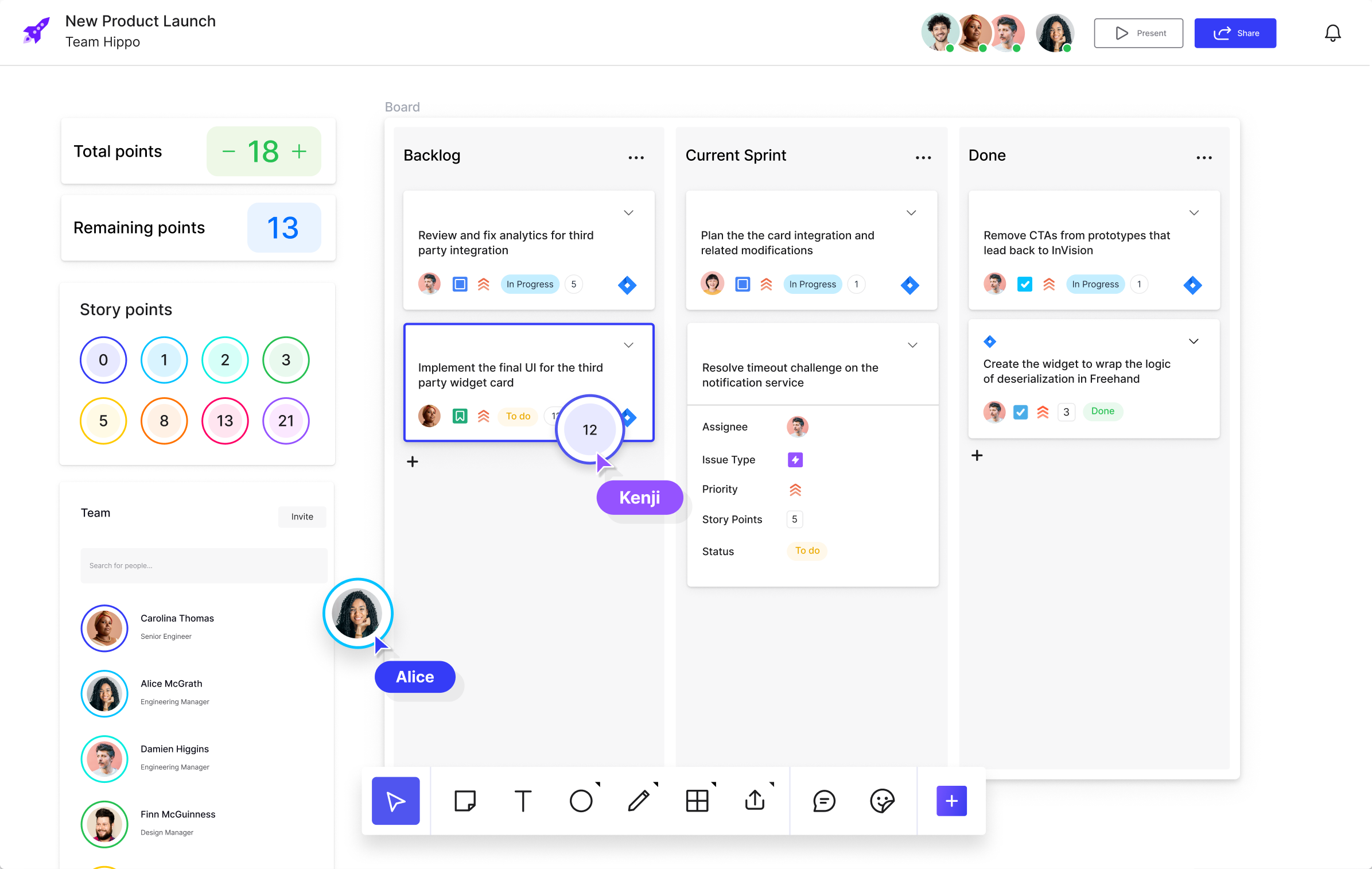
Freehand's board view before this work — useful for a single session, not built for ongoing work
Helping Freehand evolve from a collaborative canvas into a workflow platform for cross-functional teams.
InVision had strong awareness in design, but its position as a prototyping tool had weakened, and recent product launches hadn't landed the way the company needed. Freehand — our multiplayer whiteboard — was the clearest opening we had to become something more useful to teams beyond Design. I led key areas of the transformation of Freehand.
I co-led design for Freehand, partnering closely with Product and Engineering leadership, Customer Success, and GTM. I was responsible for the product narrative and design direction for both the Tables/Timelines work and FreehandAI, and I stayed personally involved with several of our enterprise accounts. My team owned the interaction design, visual design, and prototyping for what shipped — team size shifted more than once across three rounds of layoffs, so headcount looked different at the start of this work than it did by the end.
Freehand's board view before this work — useful for a single session, not built for ongoing work
Freehand was good at getting a team's thinking onto one shared canvas. What it wasn't good at was helping that thinking survive past the workshop. Once the sketching was done, teams still had to move everything into separate tools to actually act on it — which meant Freehand stayed a moment in a process rather than a place teams kept coming back to.
The strategic question wasn't "how do we add more canvas features." It was how to move Freehand from a workboard — useful for a single session — to a workflow — useful for the ongoing work that came after.
I co-created the narrative for this shift, then worked with Engineering, Product, and Customer Success to break it down to its smallest useful piece. What we kept coming back to was that almost every team need — tracking work, planning timelines, organizing a backlog — depended on the same thing underneath: persistent, structured data that could be viewed a few different ways.
Rather than build tables, timelines, and boards as three disconnected features, the team built one structured-data foundation that could power all three views. That decision is what let us ship faster later and kept the product coherent as it grew.
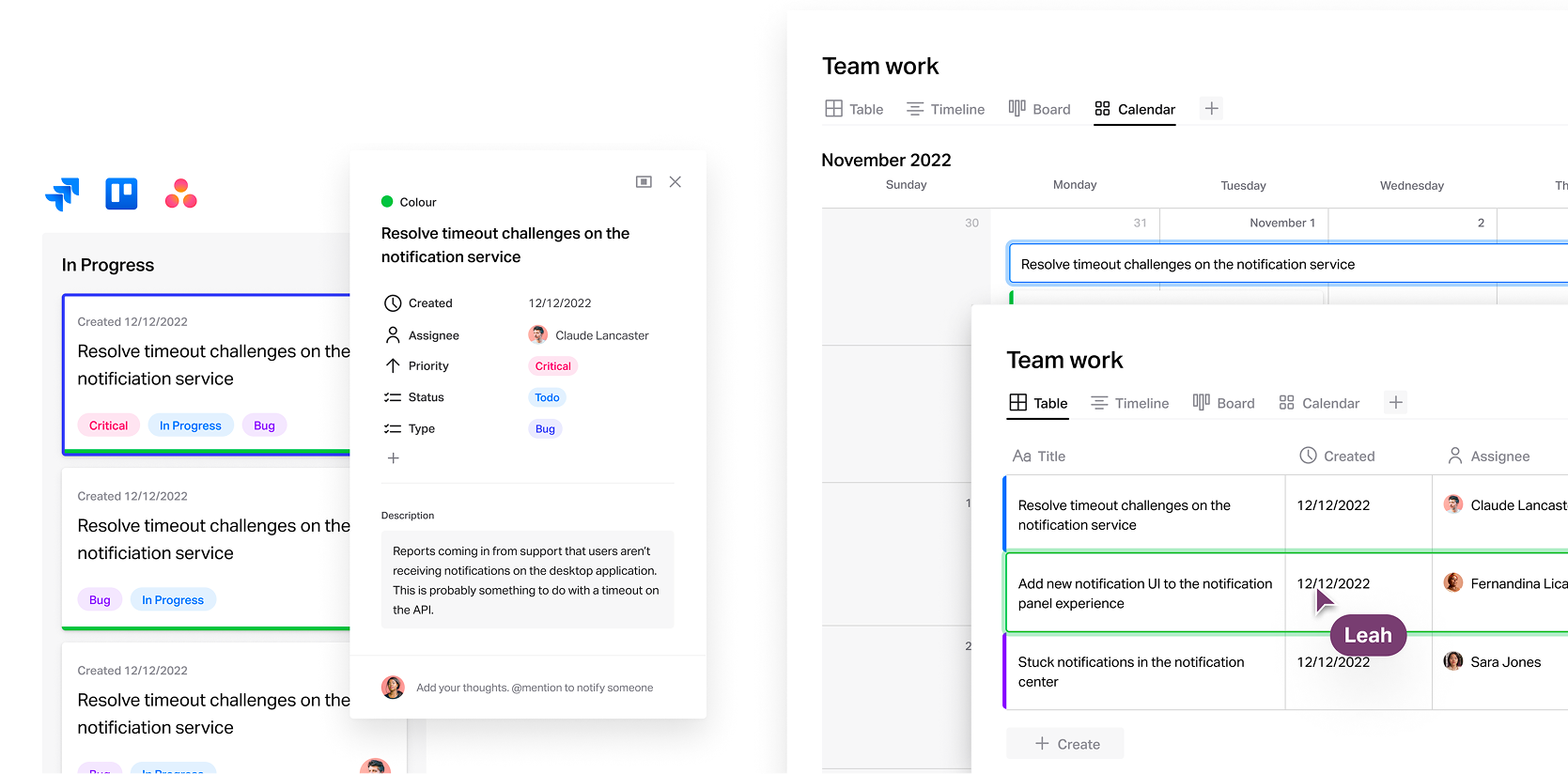
The same underlying work, viewed as a board and as a table/calendar — one data model, multiple views
I pulled together what we knew — prior research, customer conversations, competitive context, and the technical architecture already in place — into a narrative that Design, Product, Engineering, Customer Success, and GTM could all move toward together. The point wasn't to have the answer up front; it was to give five different functions a shared reason to prioritize the same thing.
We had limited runway, so I made the call to keep the team biased toward showing work early and often — internally and with enterprise clients — rather than polishing in private. That also meant being deliberate about where we innovated. Novelty had to earn its place: where an established interaction pattern already solved the problem, we used it. Where our differentiation actually depended on doing something new, that's where we spent the extra time.
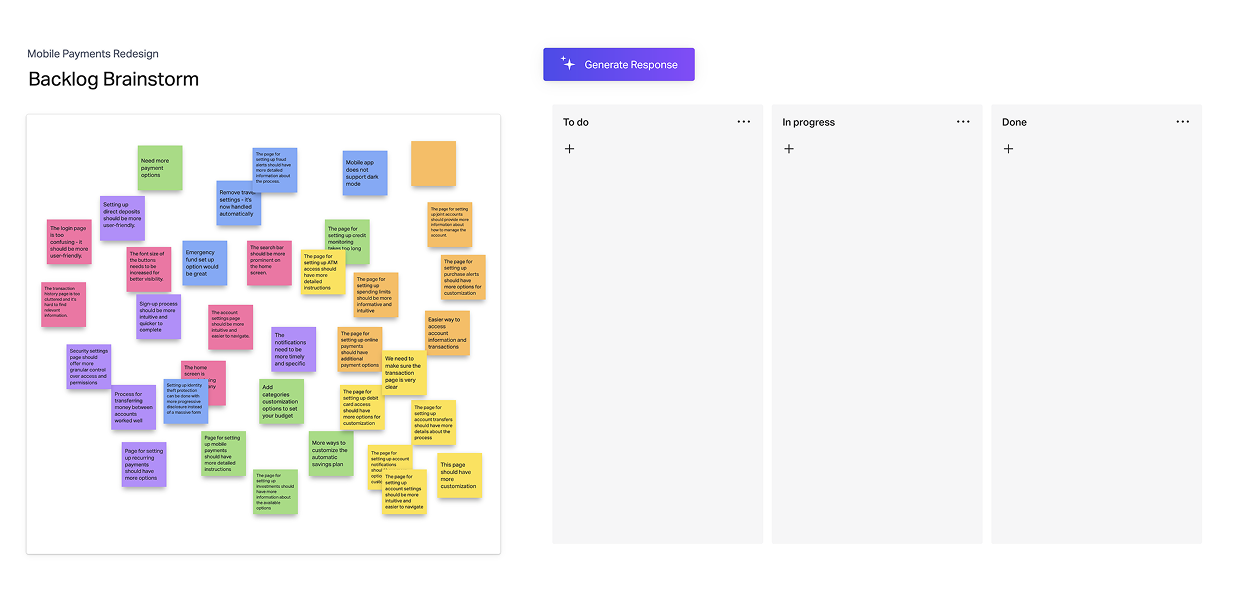
Early, unpolished work shown to the team — a backlog brainstorm shared before it was resolved, not after
I stayed personally involved with several enterprise accounts as an executive sponsor, working alongside Customer Success and GTM rather than just receiving research secondhand. That closeness mattered: it's how we learned that the overall direction — structured data, multiple views — was right, even when some of our early prioritization and details inside it were not. Being close enough to hear that distinction is what let us fix the details without losing the direction.
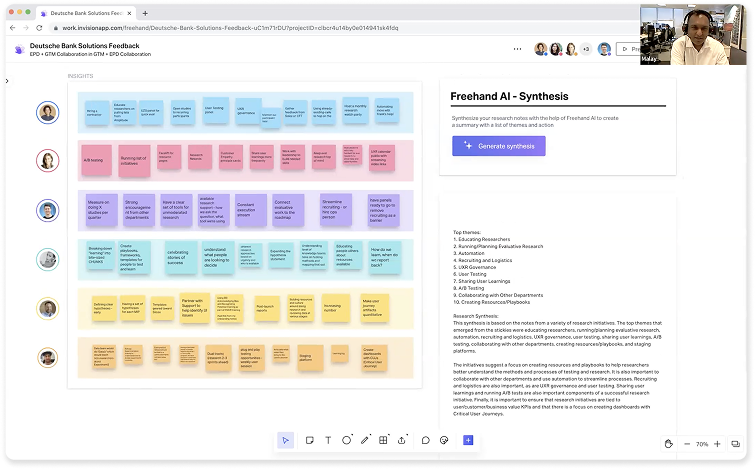
A live session with Deutsche Bank, using FreehandAI to synthesize their own feedback in real time
The underlying question hadn't changed: how do we help teams turn messy, collaborative input into something useful faster? Structured data solved part of that. Generative AI, which was quickly becoming table stakes across the category, looked like it could solve another part.
Individual ideation was already easy for most teams. What was harder was the multiplayer step — a group refining messy input together into something they could actually use. Our hypothesis: AI could reduce the manual work between messy collaborative thinking and a usable first draft, giving teams something concrete to refine together rather than starting from a blank canvas.
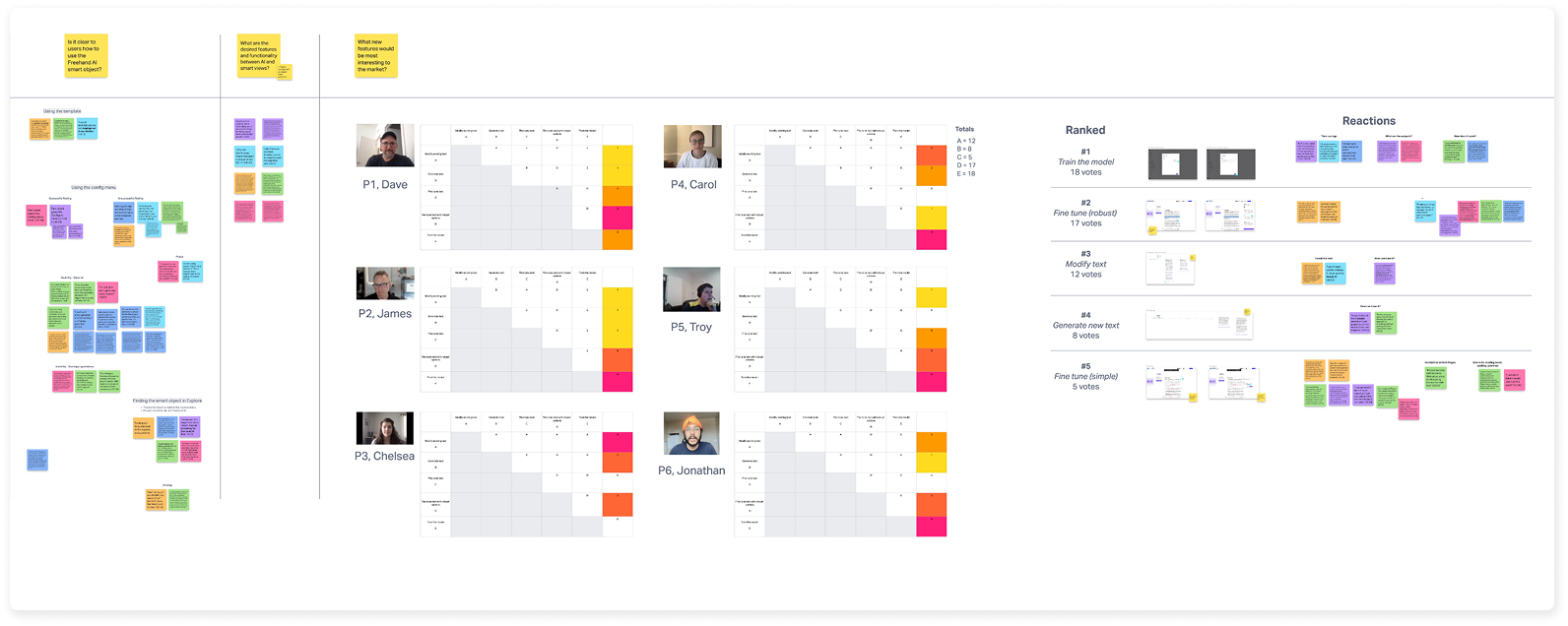
Research participants ranking which FreehandAI capabilities mattered most before we built them
I shipped FreehandAI and validated it directly with Deutsche Bank, IBM, and American Express. The response wasn't uncomplicated. Teams could see real time savings, but there was also real skepticism about the technology, some technical bugs that got in the way, and onboarding that didn't make the prompting mechanism obvious enough. For a lot of users, FreehandAI worked best as a jumping-off point rather than a finished draft.
This work shipped alongside three separate rounds of layoffs. My role shifted from coach to coach/player almost overnight, and I spent a lot of energy just keeping momentum and morale intact — not as a one-time push, but as something I had to keep actively doing, week over week.
There was also real urgency underneath all of it: legacy users were leaving, and that pressure made "move fast without breaking quality" a daily negotiation rather than a principle I could set once and walk away from. It wasn't always possible to cleanly separate what my team could control from the larger situation around us. Shipping good work under that kind of pressure is possible, but it costs something. That said, I'm extremely proud of the work that the team put into getting so many 0 to 1 features out in the market in such a short amount of time, while staying deeply connected to our enterprise customer needs. Ultimately, InVision's Freehand was acquired by Miro in November 2023, ending a bittersweet chapter for many passionate team members involved in the creation and evolution of the tool.